
Collaborative projects 2026 laureates
On Thursday, 18 February 2026, applicants for the collaborative seed project call presented their projects to a jury and the EnLife community. Discover the six projects supported by EnLife!
For this first edition of the EnLife collaborative seed projects call, applicants were invited to present their proposals before a jury and members of the EnLife community. The format combined a light application process with oral presentations and a collective discussion session involving both the jury and the audience. This approach enabled constructive exchanges and informed the final selection.
As a result, six projects were selected for funding, each awarded €150,000. In addition, one project received €10,000 to support a proof-of-concept experiment, with the aim of strengthening future funding applications.
From microfluidic systems to cell-fate dynamics, plant symbiosis and theoretical explorations of living systems, the funded projects reflect the diversity of topics and approaches supported within the EnLife program.
Sorting Cells with Collisions
Researchers involved
About the project
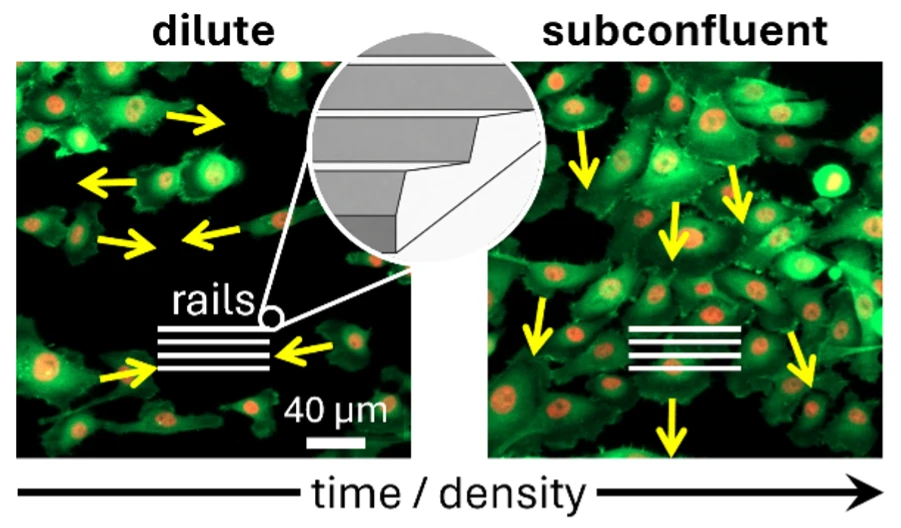
Collective cell migration of HBECs on a micro-patterned substrate with ratchet rails.
Migration is parallel to the rails at low density and perpendicular at intermediate density. Arrows: migration directions (representative subset); rails not to scale.
Programming Ligand–Receptor Signalling through DNA-Encoded Nano-Patterning
Plant–Fungal Symbiosis in Model Soils
Life Quanta
Researchers involved
About the project
To investigate this concept, this project focuses on Ewing sarcoma, a pediatric cancer driven by an abnormal fusion protein called EWS-FLI1. By combining purified proteins with synthetic DNA sequences under controlled laboratory conditions, this project will recreate and observe how these molecular assemblies form. Advanced cryo-electron microscopy will then be used to visualize these nanoscale structures directly. This research could reveal new physical principles governing gene regulation, cellular organization, and diseases linked to abnormal molecular assemblies.
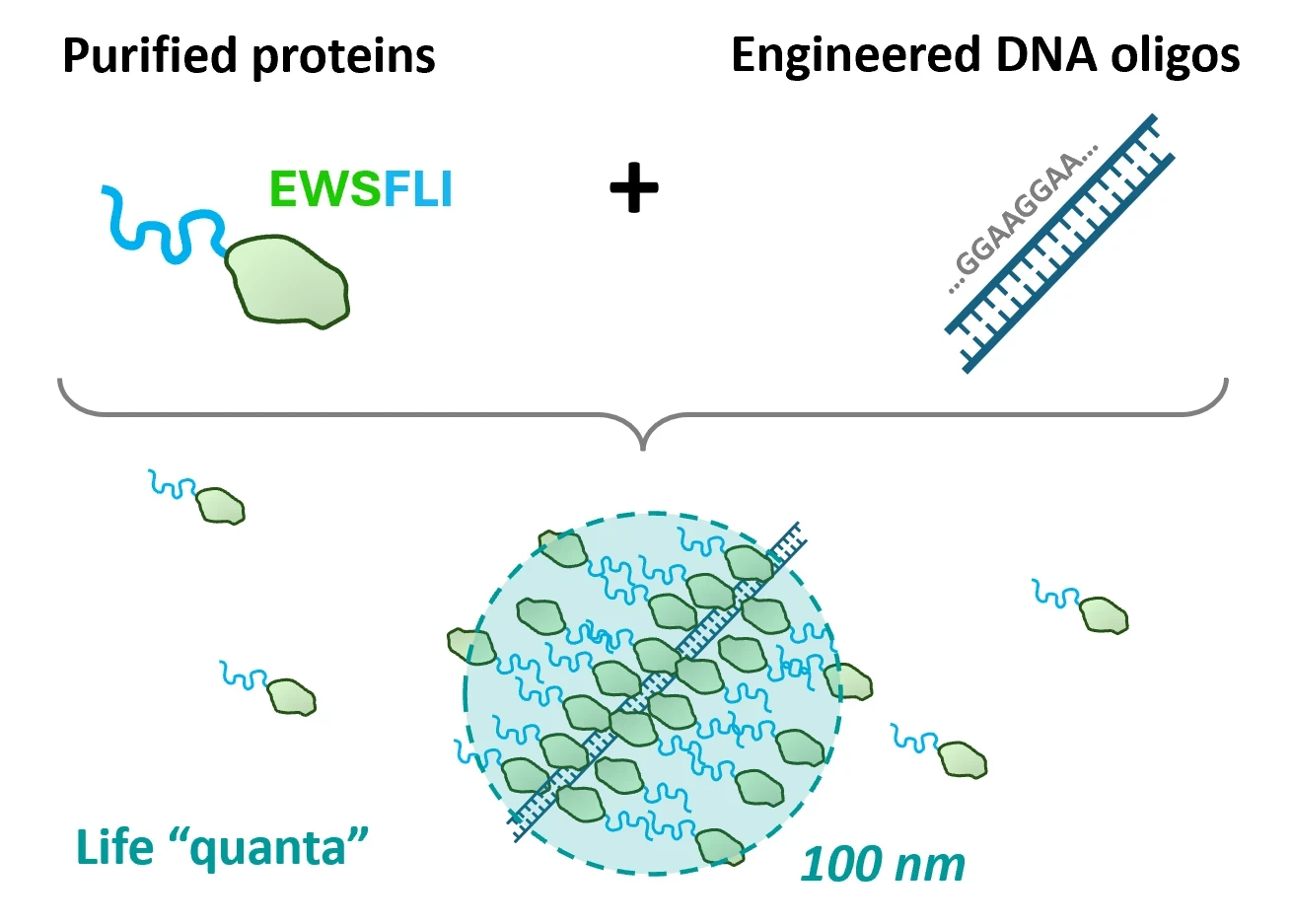
Reconstitution of “life quanta” in vitro. Purified EWS-FLI1 proteins are mixed with engineered DNA sequences containing GGAA repeats to promote the formation of transient nanoscale molecular assemblies (~100 nm). These collective structures may represent functional mesoscale biological events underlying gene regulation.